
The marvels of a seed
- July
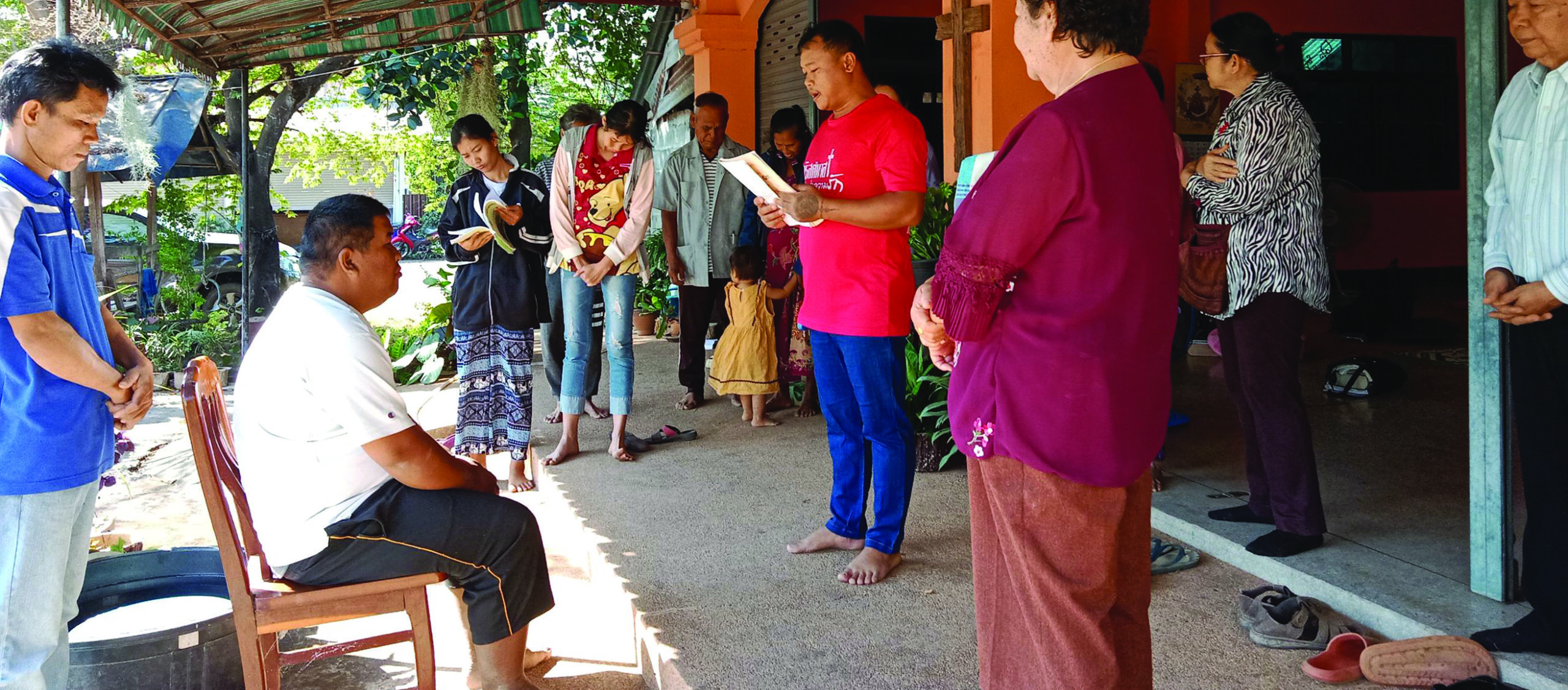
P. Tha’s neighbor Tow (seated) being baptized.
PHOTO BY THE AUTHOR
Hold a seed in your hand and marvel at the miracle of life in miniature. Packed into the tiny package is all the potential, not only for expansive growth, but also for generations of reproduction. Take a grain of yeast and think of how microbes can gradually transform their environment. Mix it with flour and water, and initially, there is no evidence of its presence. But inevitably, the yeast will awaken and gradually raise the bread for baking. These are the images that Jesus gives us for the exponential growth of the Kingdom of God. Just a seed — the small beginnings that become a tree spreading out its branches to provide sustenance and refuge for the animals of the forest. Yeast — its influence initially hidden, eventually transforming all the dough into bread that is good to eat.
In 2016, our friend Songkran got a vision to move to the Nam Yuen district and begin sharing the gospel. With the vision for multiplication he received through the leadership coaching with the Life Enrichment Church, he believed his witness would not just bring one person to faith, or start one church, but catalyze a multiplication of house-churches. Audacious for a twenty-something, self-supported lay leader with a sixth-grade education? Not when you know the viral potential of Jesus’s Kingdom.
On one particular afternoon, early in 2017, Songkran sat on a street corner on a bamboo platform and shared the gospel with a grandmother named Mae Sai. She became the first person to come to faith through Songkran’s ministry in Nam Yuen. Mae Sai was a true native, related to half the town and friends with everyone. While beset by struggles: illiteracy, diabetes, rheumatoid arthritis, and poverty due to an alcoholic husband, she offered what she had. She opened her home for worship, and herself to be family for Songkran and his wife, Lot. During the day, when she wasn’t cooking, she would sit outside, visiting with a stream of neighbors and listening to the Bible on audio.
In 2019, her daughter P. Tha and her son-in-law and grandson were baptized. P. Tha’s conversion was dramatic with dreams, miracles, and deliverance, but also a bumpy process. In 2021, there was such a sharp conflict with P. Tha, in which she left the church and forbade Mae Sai from fellowshipping. This went on so long that we all thought we’d seen the end of the story. Imagine our joy and surprise when, in 2022, again, dramatic dreams, miracles, and deliverance restored P. Tha to faith and fellowship. Over the next three years, P. Tha matured and shared her story with all their friends and family. Mae Sai and P. Tha intentionally shepherded people in three households over the next few years. Mae Pin found freedom from alcohol addiction and a new family in Christ, and then brought her sister to faith. Mae Bua and her son Tow became faithful members. From 2022 to 2024, P. Tha prayed and reached out to her neighbors who were experiencing demonic oppression. In 2024, that family also professed faith. Now P. Wa and her daughters, Luck and Man, are hosting church in their home and actively sharing the gospel with their neighbors.
What is interesting to note is that Songkran, as the leader of this growing church, was not coordinating these evangelistic efforts everywhere. What made this growth possible was the nurture of disciples who were ready and able to make disciples themselves. It is no coincidence that Jesus uses examples from nature to point us to principles of organic growth. In the natural world, one of the key signs of life is that it can reproduce. Jesus intended the Kingdom of God to grow and spread in the same way — generations of exponential growth by multiplication through reproduction.
In 2023, Songkran’s family moved away to a different part of the district and began to worship there, sharing with a new sphere of neighbors. This forced Mae Sai’s household to worship independently. Meanwhile, long distances and tight budgets forced two other households and their accompanying neighbors to stop driving into Mae Sai’s home on a Sunday morning and start to lead their own house churches in their own villages. So, suddenly, our one house church became four. It has always been the vision for house churches to multiply, with the goal to develop leaders and keep church affordable and easy to reach — but for isolated believers, the draw to gather in larger groups for fellowship and encouragement is so strong. The tension is real: too lonely and you die, too clustered and you don’t multiply!
These two forces — that of gathering and scattering — were tensions that Jesus’s first disciples felt as well. We see it played out in the book of Acts. Thousands of disciples gathered for sweet times of fellowship upon receiving the Holy Spirit, but after persecution came to the new church in Jerusalem, they were dispersed throughout the Roman Empire, and naturally, churches formed around them. Scattered in hostile pagan societies, the sense of belonging and connection with the broader church remained vital for the early church to survive. Through the rhythm of gathering and scattering, the Jesus movement spread throughout the world.
During this time in Nam Yuen district, however, we also experienced two completely failed house church plants, and many people who, after dramatic and beautiful encounters with Jesus, baptism, and tons of discipleship, succumbed to discouragement and left the faith. I estimate that this was the case for at least three-quarters of the people we baptized. We suffered a network-wide conflict that turned into a church split, both of Songkran’s parents died, Songkran and Lot experienced years of sickness and spiritual attack, and two times we tried to multiply from one house-church into two, and failed. All of that was in addition to COVID, our own challenges, and the normal challenges of a context of poverty. Songkran regularly confessed that he wanted to give up, and at times, my husband, Steve, and I felt the same.
In organic gardening, you beat the bugs not by removing every threat, but by feeding the plants so that they grow and bear fruit faster than the losses. In Jesus’ movement, I notice that the same principle applies. The growth of the church has to outpace attrition in two ways: firstly, by being grounded in the nourishment that God provides. It is the soil that makes a garden. God’s word, God’s wisdom, and God’s Spirit are all there for us. Jesus calls this “abiding in the vine.” Secondly, as we abide in the vine, Jesus encourages us to sow seed prolifically. The sower is out there throwing seed, knowing that only some of it will fall on good soil. This is also the case in evangelism and discipleship in our region. Attrition is high, so sowing must be generous!
And that’s the beauty of it. The seed — that miracle of life contained in a kernel, in a word of truth, in a healing embrace — contains the energy of the Holy Spirit. Our invisible prayers — like yeast — breathe out the life of Jesus into contexts of oppression — are like microbes that begin to transform their environment. Here and there a seed will sprout and grow into a tree laden with fruit and more seeds. Just wait for it, the yeast will come alive and spread.

Bethany Tobin and her family serve jointly with EMM and VMMissions in Thailand.
Messenger is a monthly newsletter and prayer guide
Sign up to receive the email or print versions below