
Unexpected outcomes
- August
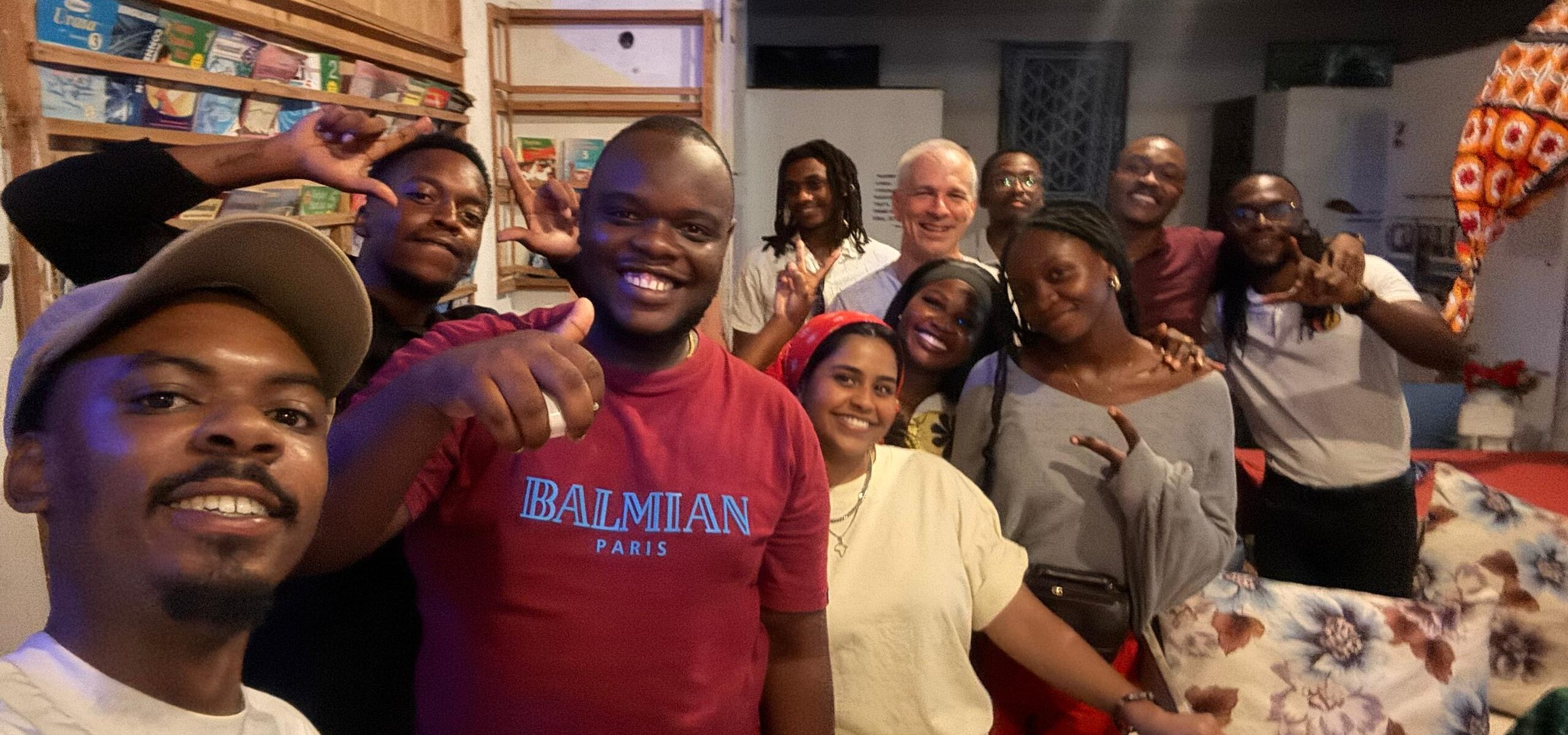
Jonathan Bornman (center) with young adult attendees for a showing of Unexpected Peace in Tanzania.
PHOTO PROVIDED BY THE AUTHOR
Watching Unexpected Peace (2024) with a group of young Tanzanians, a few months after a major outbreak of political violence, was far and away the most intense and engaged audience that I have sat with. They stayed after the film for two hours debating the issues raised and talking about the application of lessons learned for their situation. None of the film’s stories came from their region, but they felt connected to the themes and internalized the message! What has emerged as most helpful for evaluating how different audiences connect with the film is to ask about their proximity to violence or their experiences of living in a mixed faith community.
Unexpected Peace is a documentary about nonviolence in a polarized world. It is a beautiful film with an original musical score. The camera work and the editing are excellent! Production quality is on par with movie industry standards. The best place to watch the film is in a movie theater. But most people won’t have that experience because the people who most appreciate the film don’t have movie theaters in their neighborhoods.
The film sets forth three stories, presented as parables. Stories about people and communities dealing with interrelated issues of forgiveness, nonviolence, and peacemaking. These true stories come from Christian and Muslim communities responding to violence and division. Our goal as filmmakers, from the very beginning, was to make people think and ask questions. We wanted to tell these stories in a parable-like way to help people think about their own story, their own community, and the challenges they face.
At first glance, it appears that people gravitate towards the story most familiar to them. Mennonites in Lancaster, Pa., can relate to the familiar Amish story but struggle to connect with the other two stories. Murids in Harlem, N.Y., were wowed to see their own story on the big screen. And, when touring the film in Central Java, Indonesia, people barely understood the Amish story but found the complex interaction between the Christian pastor
and the Muslim militia commander engaging! Not to mention the fact that it was in their own language, whereas in the first two stories in the film, they had to read the subtitles.
When I introduced Unexpected Peace at the Christian University of Salatiga, in Indonesia, I felt a prompting from the Holy Spirit to set the film within a spiritual context. I turned to Ephesians 6:10–17, and I read aloud, “Put on the full armor of God, so that you can take your stand against the devil’s schemes.” I said that in our polarized world, one of the devil’s schemes is to spread dehumanizing hate speech, fear, and violence. Our film stands in resistance to these schemes. I continued reading, ending with verse 15, “With your feet, fitted from the readiness that comes from the gospel of peace.” Lifting one foot and pointing to my shoe, I invited people to embrace the way of Jesus and the gospel of peace.
Unexpected Peace is for everyone from any background and any faith. On April 7, 2026, I showed the film to a Muslim audience in Harlem at the ASA, a Senegalese community center. In the audience were four of the people I interviewed for the second story in the film, about the Murids who responded to violence with nonviolence and trust in God. Just before we started the film (6:30 p.m.), the imam came to me and requested that we pause the film for the evening prayer; Muslims pray five times per day at appointed times. We stopped the film at 7:25 p.m. Mats were brought out, and the imam led those gathered in the evening prayer time, a 20-minute break for prayer, then we resumed the film. The audience appreciated the film and was glad to see themselves and many of their friends in the film.
Discussion afterwards was enthusiastic, and no one hurried to leave. One woman asked, “What inspired you to make this film?” I replied, “I’m a Christian. I follow Jesus the Messiah. He is called the Prince of Peace. So, I made this film about forgiveness and nonviolence and peace because I follow the Prince of Peace.” My answer elicited many approving nods and smiles. One woman said quite loudly, “Isn’t that how it should be?”
The next day, Muslim chaplain Aisha McCord sent me a message, “Thank you for a wonderful, peaceful experience. The movie is very important because it spiritually and socially guides those who watch it towards a higher, more powerful, and enlightened path.” She added, “We need more movies like this to fill our conscious and unconscious mind with better humanitarian choices in times of emotional and spiritual need.”
And the imam for the community, Imam Abdou Mbaye, wrote, “Thank you, I learned some important lessons:
In life, we should always plant good seeds, because one day we will be gone, and what we leave behind will either be forgotten or will live forever in people’s hearts.
- The Amish community teaches us about peace, tolerance, and forgiveness.
- The Murid community shows us the importance of being peaceful and sharing with others.
- The Solo community in Indonesia teaches us how to build peace, even when it is unexpected.”
Unexpected Peace was broadcast by the central Pennsylvania PBS TV station, WITF, on March 19 and 22, 2026. Getting on PBS is a major accomplishment for any documentary, and we are greatly honored that they chose to show our film to their viewers. As a result, the film is now available on their website and will soon be available to PBS stations nationwide.
A Mennonite congregation in Lancaster played the livestream from WITF of the March 22 TV broadcast in their church sanctuary, and over 40 people gathered. Excellent discussion followed as members of the congregation wrestled with the stories and ideas. With the U.S.-Israel war against Iran very much on everyone’s minds, people talked about conscientious objection (as seen in the documentary’s introduction) and about our complicity in the war as American taxpayers. We even had an outspoken heckler — not a church member — who had come to provoke.
Thanks to European Mennonite friends and partners, plans are underway for a European Tour of Unexpected Peace in January and February 2027. The plans include dubbing the documentary into several languages, including French, which would be a blessing to West Africans as well. At the same time, Mennonite Bishop Amos Muhagachi and the Tanzanian Peace Building Initiative are working on dubbing the film into Swahili to reach the millions of Swahili speakers in East Africa.
Unexpected Peace was produced by Director Michael Hostetler and Director of Photography Ehab Assal, along with me, and in partnership with Eastern Mennonite Missions, as well as many, many donors. This journey continues to surprise me, and I look forward to seeing how God will use this film in the years to come.

Jonathan Bornman is a member of EMM’s Christian-Muslim Relations Team.
Messenger is a monthly newsletter and prayer guide
Sign up to receive the email or print versions below